1890s Truss Frames in Chicago
In the 1890s in the bicycle manufacturing trade, some companies wanted something to distinguish their product from their competitors. This was true in Chicago where there were several small startup bicycle manufacturers who competed for the local bicycle sales. One of the unique frame designs that came from Chicago was a bifurcated or paired seat tube frame.
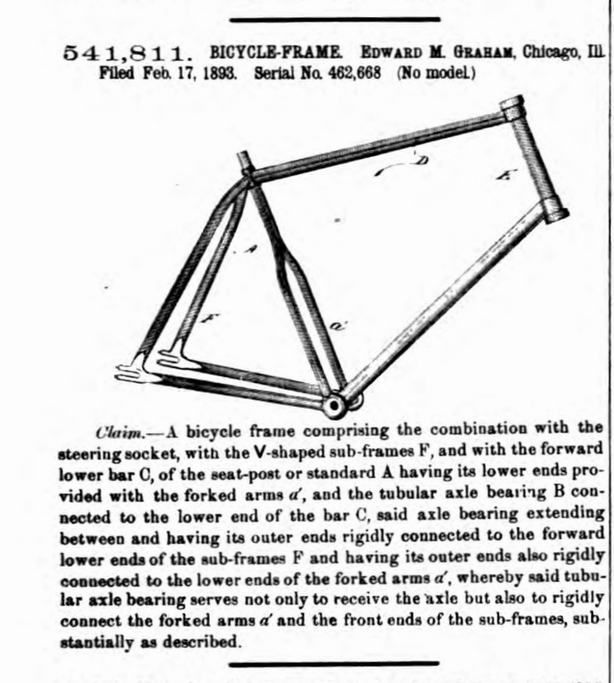
The Chicago style bifurcated seat tube frame bicycle was eventually patented by Edward M. Graham in 1895 and a little later the ladies version was patented by Frank T. Fowler. Frank Fowler christened these frames as “Truss” frames.
This post is about the companies and some of the people involved in the manufacture of the seat tube truss frame.
Moffat Cycle Company
The Moffat Cycle Company was a startup bicycle manufacturing company founded in January 1891 in Chicago. The primary founder was George Moffat a cycling enthusiast. The by the summer of 1891 the Model B Moffat bicycle was selling and performing well in races.
In October of 1891 there was an announcement of a new model with a double frame bicycle. This was not a bifurcated seat tube frame, as I had first thought that it might be..

The frame appears to have been only limited production in 1891. Here is a link to the 1892 Moffat Cycle catalogue.
https://thecabe.com/forum/threads/wanted-1891-moffat-bicycle.199820/
In August of 1892 the Moffat Cycle Company was forced into bankruptcy auction due to the treasurer of the company Mark Hill. At the auction Mark Hill purchases the factory assets and Frank Fowler purchases the retail store assets.
Hill Cycle Manufacturing Company
Two weeks after the auction purchase Mark Hill and Frank Fowler resume the operation of the former Moffat Cycle company. In October the Hill Cycle Manufacturing company is formed and their bicycle is named the Fowler.
In November there is a trade news story about Hill Cycle Mfg. new model with a wishbone seat tube. The Hill cycle advertising does not say “Truss” frame.
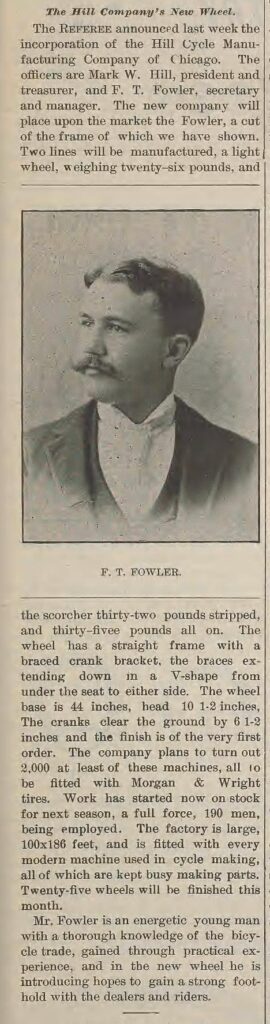
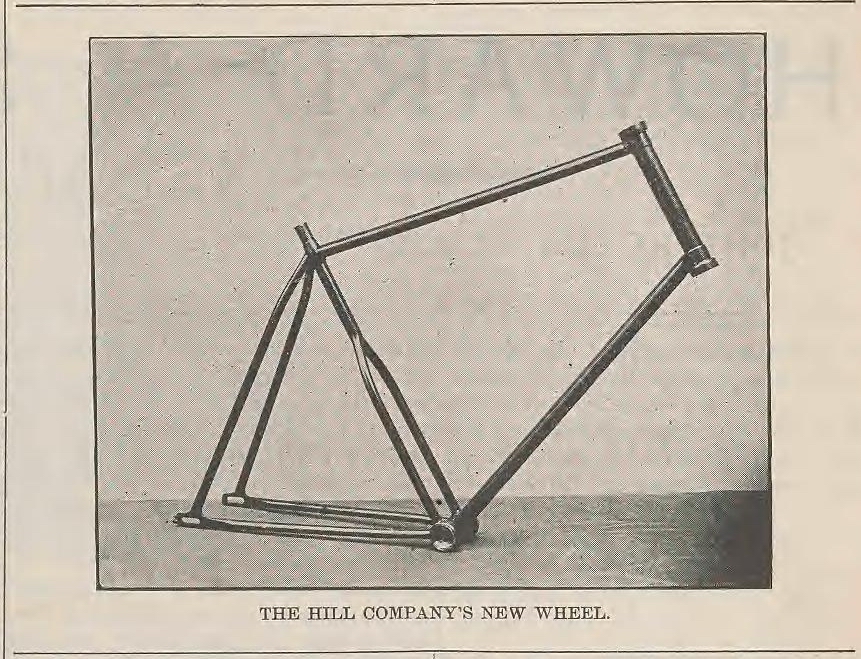
A patent is applied for in 1893 and granted in 1895 to Edward M. Graham, the superintendent of the Hill Cycle Manufacturing factory.
Mark Hill dies unexpectedly in April of 1894. George Hill, son of Mark Hill, dies in July of 1895. Frank Fowler, son-in-law of Mark Hill, is now in charge renames the to Fowler Cycle Manufacturing Company.
Fowler Cycle Manufacturing Company
The Fowler bifurcated or paired seat tube frames continue to be manufactured. When the patent for the frame is granted in June of 1895, Frank Fowler invents the name “Truss” frame.
Edward Graham departs from Fowler Cycle Manufacturing for International Manufacturing Co. in September of 1895. Graham owns the patent for the Chicago style truss frame. International Mfg. now begins to manufacture and advertise a truss frame bicycle.
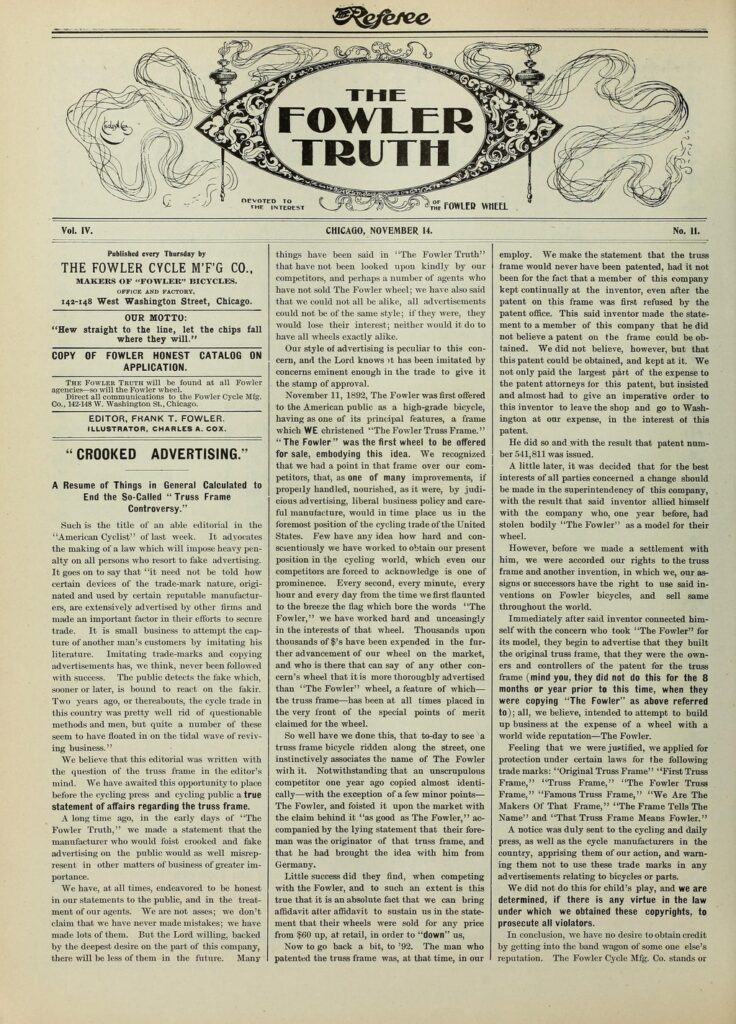
Frank Fowler appears to have been unhappy with another Chicago style truss frame manufacturer. An advertising war breaks out between the two companies in the bicycle trade magazines. Fowler claims to be the original manufacturer and International claims they have the patent holder.
Frank Fowler’s last comment on the issue was on November 14, 1895. In the Fowler Truth there is a reference to a German immigrant
Frank Fowler filed for a patent on the ladies version of the truss frame on December 17, 1895.
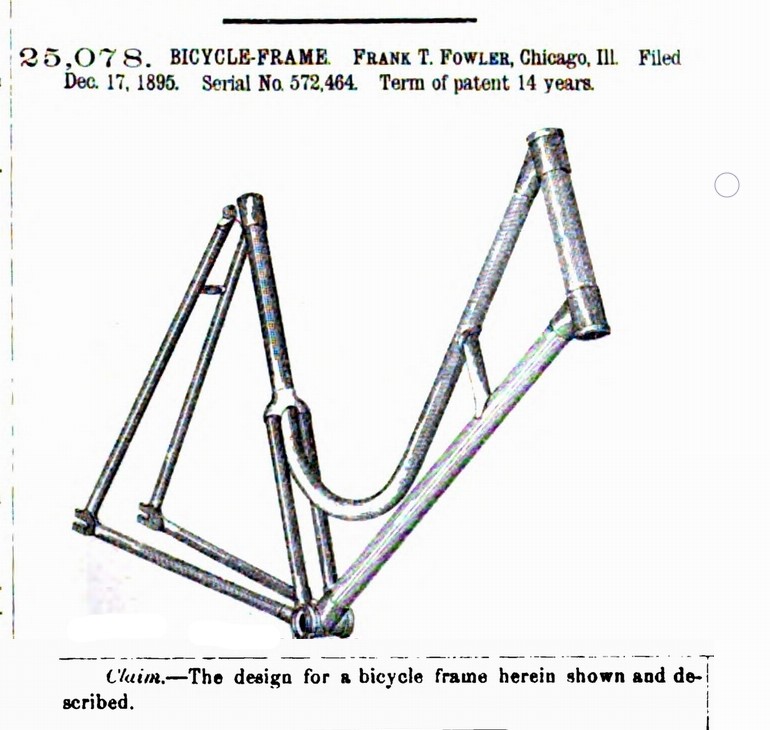
In January 1896 Frank Fowler sells his share of Fowler Cycle Manufacturing which makes him a wealthy man. In late 1897 the company goes into bankruptcy and Frank Fowler purchases the assets at the bankruptcy auction.
International Manufacturing Company
The International Manufacturing Company was founded in October of 1894 and the name of their bicycle is America.
The news story does not state who the financial backers are or how much capital was invested. This may imply that the company is privately held. The company had no direct ties to the Hill Cycle Mfg. Co. However, some of the people at International came from the Hill Manufacturing Company.
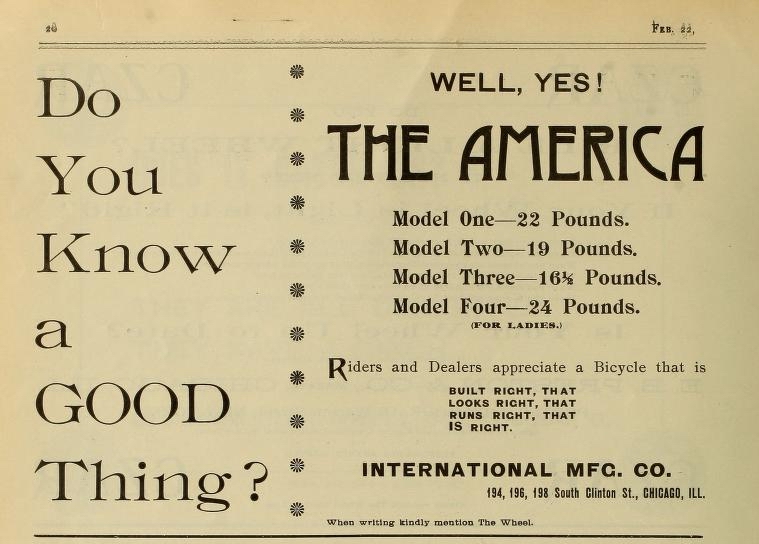
At first, the America models are not the Chicago style truss frames. An International advertisement from February 1895 lists four models and no truss frame model is mentioned.
The company’s factory manager, Ignaz Schwinn, departs from International Manufacturing to form another bicycle manufacturing company.
International needs a new factory superintendent. That person would be Edward Graham from Fowler Cycle Manufacturing.
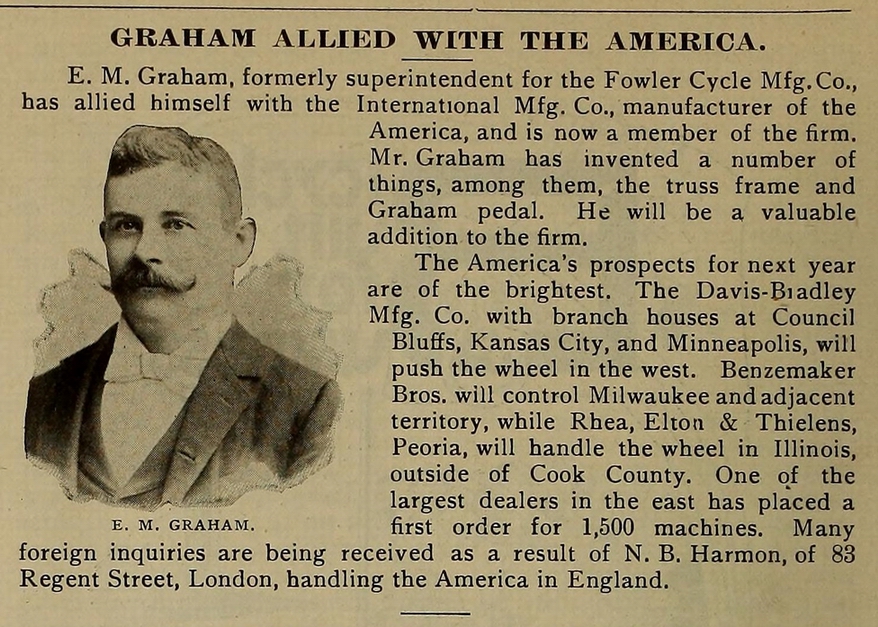
Almost immediately International Manufacturing advertised a Chicago style truss frame bicycle.
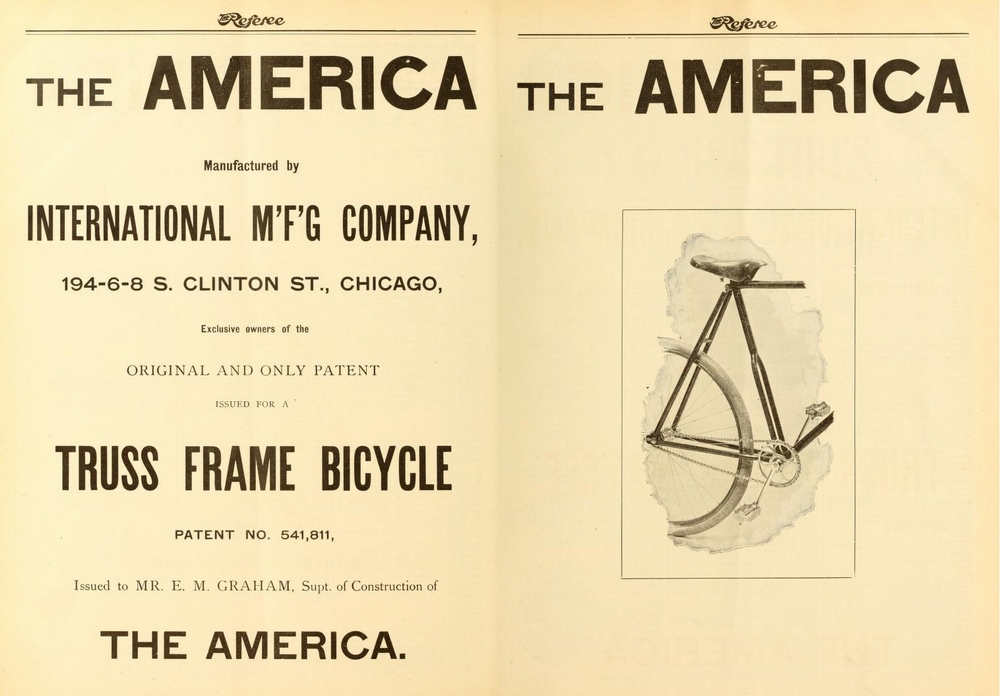
The connection of truss frame bicycles to International is the employment of the patent owner, Edward Graham.
America Cycle Manufacturing Company
In April of 1896, International Mfg. Co is renamed to America Cycle Manufacturing Co. and continues to manufacture the America brand of bicycles. J. Harley Bradley is the president of the company. The factory is located in The Bradley Building on Fulton and Jefferson streets.
Edward Graham is still with the company and the Chicago style truss frame continues to be manufactured.
Edward M Graham
Probably the first superintendent or foreman for the Moffat Cycle Co was Edward Graham. In the Lakeside directory of Chicago for 1892 Edward Graham is listed as a foreman at the address of the Moffat Cycle Company.
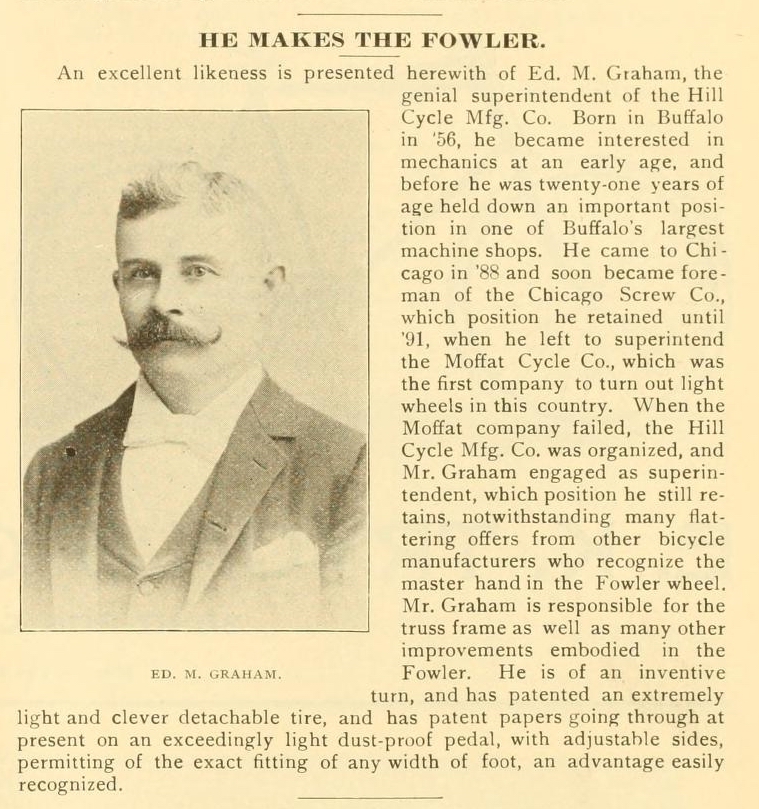
Ignaz Schwinn at Moffat Cycle Co.
Came to Chicago at the end of April in 1891 and was employed at the Moffat Cycle Co. In the Lakeside directory of Chicago for 1892 Ignaz Schwinn occupation is blacksmith. Moffat Cycle changed factory locations twice 1891, so Ignaz would have well versed at moving into new factory space.
Ignaz Schwinn at International Manufacturing
One of the people to move from Hill Mfg. to International Mfg. was Ignaz Schwinn. He was in charge of organizing the new factory. There is a publicity photograph of Ignaz Schwinn with Baby Bliss wearing a sweat shirt emblazoned with “AMERICA”.
ignaz Schwinn tenor at International Mfg. is described in this quote from page 9 of “Fifty Years of Schwinn Built bicycles”:
“The enterprise was not managed to his liking, and in 1894 he severed his connection with the International Company.”
The year given for leaving, 1894, is probably incorrect, because the company was only established in October of 1894. Also, Ignaz Schwinn would have been unemployed for almost a year until the founding of Arnold, Schwinn & Co. in October of 1895. It seems to me that Ignaz would have left International in the year 1895 and before Edward Graham is hired.
Here is a news story about International Manufacturing which confirms that the company may not have been well managed.
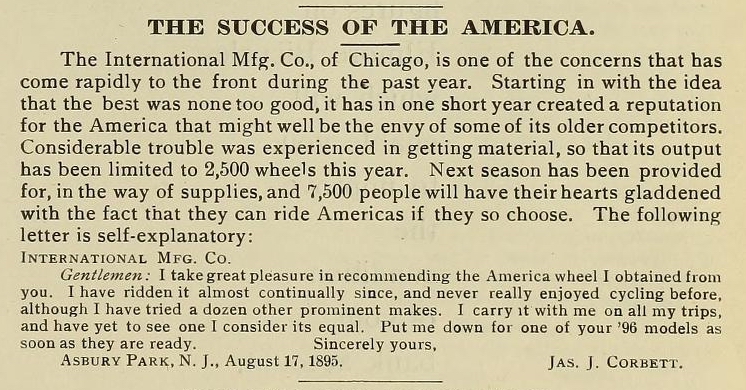
Not great production numbers far any company in 1895 and probably frustrating for Ignaz Schwinn. By comparison, Arnold, Schwinn & Co.’s initial production was 3,000 bicycles between November 1895 and April 1896.
It seems unlikely that Ignaz Schwinn had much of anything to do with the Chicago style truss frame. He would have helped manufacture this style of frame at Hill Cycle Mfg., but not at International Mfg.. If this frame was a good design or Ignaz’s design (as implied by Frank Fowler) why did not Arnold, Schwinn & Co. manufacture this style of frame?
Conclusion
The Chicago Style truss or bifurcated frame was the creation of Edward Graham. Large numbers were manufactured by the Hill Cycle Manufacturing company with the Fowler name. Later, when Edward Graham moved to the International Mfg. Co., they also manufactured the Chicago style truss frame with the America name.
Note: This post was edited the day after first publication. The edit was due to the posting of the 1892 Moffat Catalogue by member Blue Streak at The CABE. Much thanks for that posting.