Moffat Cycle Company: The Moffat Affair
With the initial success of the Moffat safety bicycle the company positions itself to become a larger manufacturer. This requires new capital to put in place a larger factory.
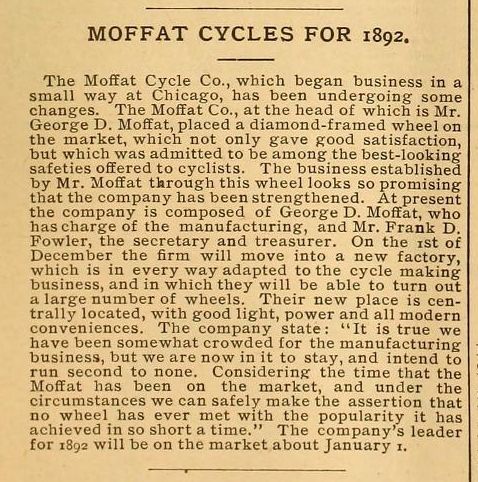
In November 1891, the Moffat Cycle Co. takes on new investors and in December with the new capital moves production to a larger premises on Washington Street.
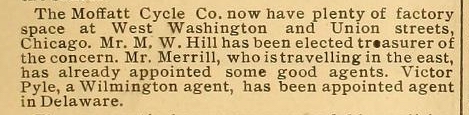
With the new investors, George Moffat is still the president and put in charge of manufacturing. Frank T. Fowler is Secretary and treasurer. In December, Mark Hill is elected as treasurer.
Who were the new investors?
Frank T. Fowler came to Chicago in 1885 at the age of 18, from Beverley Ohio. At some time Frank Fowler marries Winnie Hill, the daughter of Mark and Caroline Hill. He has no previous association with the bicycle industry. He becomes a member of the Ashland Club in Chicago.
Mark Hill came from the railroad locomotive industry. He seems to have the money to invest in the 1890s rage for safety bicycles.
Did George Moffat know either of these gentlemen before they invested in Moffat Cycle Co?
New factory
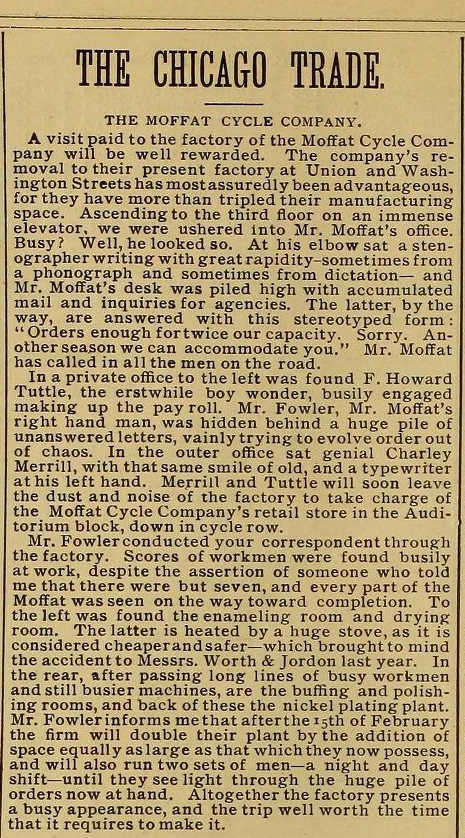
The new Moffat factory is running very well and production appears to be meeting the demand.


Smooth sailing?
The factory of the Moffat Cycle company by all reports is running smoothly. What could possibly go wrong? While not reported at the time there was apparently friction between Mark Hill and George Moffat.
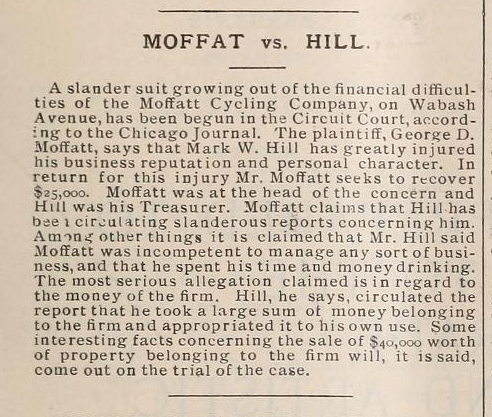
The Moffat Affair
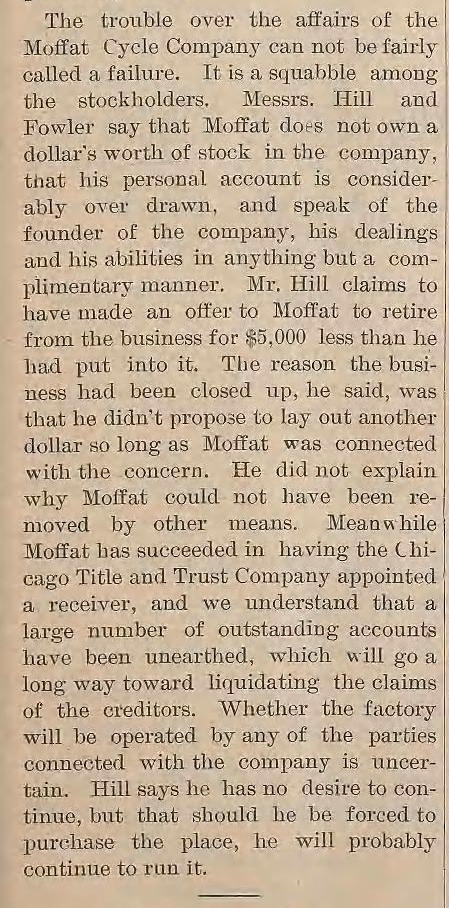
Mark Hill appears to have engineered a scheme to force George Moffat out of the Moffat Cycle Company. Mark Hill is the treasurer. There is a note or loan of $8,992 from Mark Hill’s wife Caroline Hill to the Moffat Cycle Co.
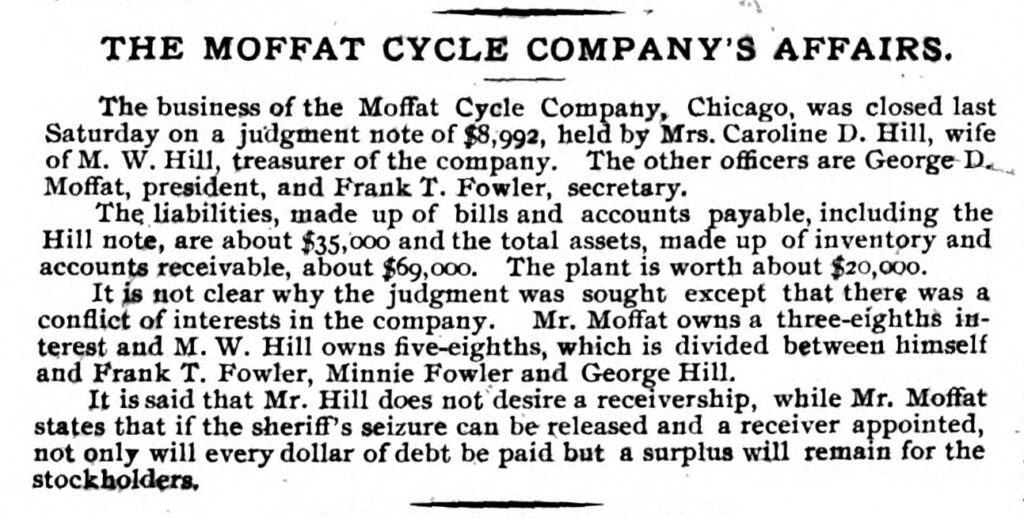
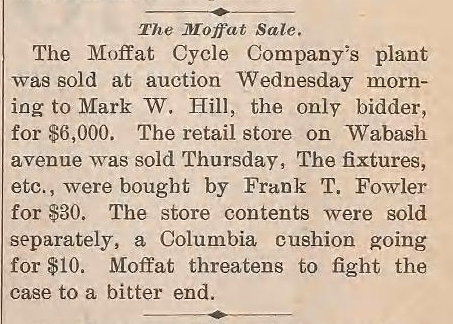
Somehow this loan ends up with the sheriff or in the courts, I do not know how the system worked. On July 30, 1892 the sheriff closes the Moffat store and factory. A petition is made to have a receiver installed to manage the financial affairs of the company. The receivership never happens. The company assets go to bankruptcy auction on August 11. The factory assets are bought by Mark Hill at well below fair value and the store assets are bought by Frank Fowler.
The company had $19,000 in accounts payable, which was used to pay the $8,992 to Mrs Hill. Other creditors were not so lucky and tried to have the whole process overturned.
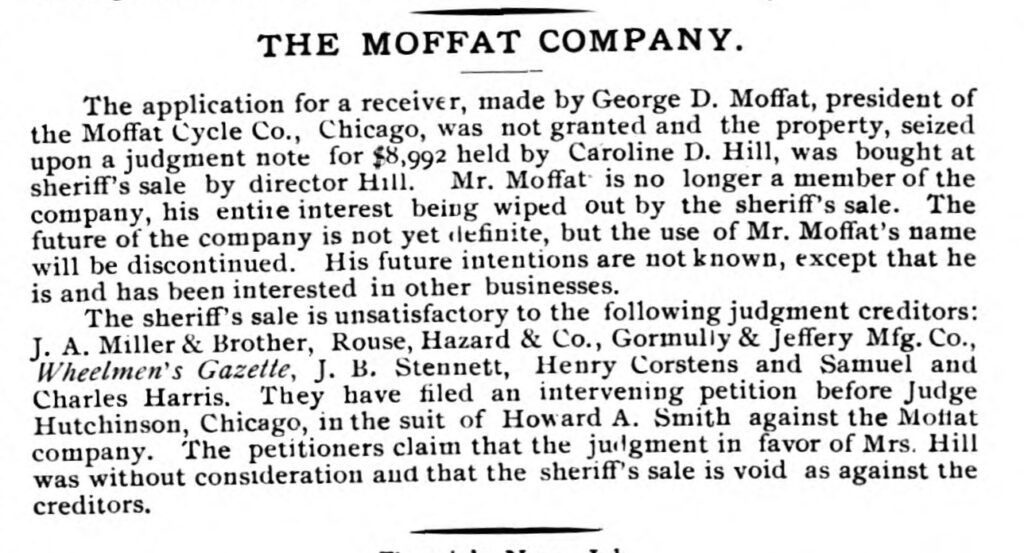
The bankruptcy and sale were a done deal. The former Moffat factory restarts in the week of August 22. The Hill Cycle Company is incorporated in October and the name of the bicycles is the Fowler. Frank Fowler managed the factory.
In the space of two week Mark Hill had forced the Moffat Cycle Co. into bankruptcy and scooped it up the assets on the cheap.
Business Lessons
In reading account of Ignatz Schwinn in Chicago prior to the start of Arnold, Schwinn & Co., the impression is given that he was bidding his time. During this whole Moffat affair, Ignatz Schwinn probably had a very good view of what was going on. What could he have possibly learned? By the end of Moffat Cycle Co. in August 1892, Ignatz Schwinn already knew much of the factory and manufacturing side of the bicycle industry. What about the business and financial side?
First: Know with whom thou doth business. George Moffat it appears did not know his new business partners. Ignatz Schwinn, I think, was always carefully about who was part of Arnold, Schwinn & Co. He had worked with William O’Connell and Ed C. Bode prior to forming his own company.
Second: Do not be financially indebted, to anyone. Aside from Adolph Arnold, Ignatz Schwinn appears never to have taken on financial partners or loans. Ignatz probably paid cash for March-Davis Company assets in the receivership sale. He bought out his partner Adolph Arnold. He is reported to have written a cheque for Excelsior Motor Manufacturing and Supply. He warned his son Frank to always have the money in the bank when doing financial transactions.
These were good lessons. I do not think that anyone ever took advantage of Ignatz Schwinn in a business deal.
What happened to the Moffat Cycle principles
George Moffat continued with other business ventures in Chicago, but none in the bicycle industry.
Mark Hill founded the Hill Cycle Company in October 1892 from the remnants of the Moffat Cycle Company. He died on April 13, 1894, about 18 moths after forming the Hill Cycle Co.
Frank T Fowler worked for the Hill Cycle Company. After the death of George Hill (son of Mark Hill) in 1895, Frank became the principle owner of Hill Cycle and renamed the company to the Fowler Cycle Co. In January 1896 he sells his stake in the Fowler Cycle Co and made a lot of money. His timing of the sale was good as the 1890s Bike Boom was coming to an end. Frank started another bicycle company and continued in other business activities. He became an alderman in the city of Chicago.