The Moffat Cycle Company: first to employ Ignatz Schwinn
While researching Ignatz Schwinn I found that there is a misrepresentation of the name of the company to first employ Ignatz Schwinn in Chicago and his role in that company.
According to page 9 of “Fifty Years of Schwinn-Built Bicycles”, the first USA company to employ Ignatz Schwinn was Hill & Moffat of Chicago. This book is the only reference that I can find to Ignatz Schwinn’s early employment in Chicago. This book is constantly used as a reference to Ignatz Schwinn’s first employment in Chicago.
Unfortunately there was never any companyin Chicago by this name. This “Hill & Moffat” probably refers to The Moffat Cycle Company. This enterprise later transformed into at least two other company with the names: the Hill Cycle Manufacturing Company and the Fowler Cycle Company.
The Moffat Cycle Company is an interesting case study about the bicycle business in Chicago in the 1890s and the USA legal system around corporate indebtedness, receivership, and bankruptcy. All of this was no doubt very educational for Ignatz Schwinn.
An interesting note is that during the rise and fall of the Moffat Cycle Company I found no reference to Ignatz Schwinn. I found references to Ignatz Schwinn in the early 1890s but not in the bicycle trade magazines of the day that were available to me. Other people who would help form Arnold, Schwinn & Company are mentioned in the bicycle trade magazines.
Bicycle Industry Background
In the 1890s bicycle manufacturing was still a new industry. Prior to 1890 the style of bicycle that was manufactured was called the ordinary, sometimes known as the Penny Farthing. By 1890 a new style of bicycle called the safety bicycle was in demand. The safety bicycle was more complicated because it was not direct drive. The chain drive or shaft drive of the rear wheel added complexity to the manufacturing process.
There were two general types of bicycle manufacturers. The first were large manufacturers of metal goods who saw bicycles as another commodity to manufacture. These companies often existed before safety bicycles and the 1890s bicycle fad. In Chicago some of these companies were Adams & Westlake, St. Nicholas Toy Co., Western Toy Co. (which became Western Wheel Works), Gormully & Jeffery Mfg Co., Ames & Frost Co., A. Featherstone and outside Chicago arms manufacturers.
The second type of bicycle manufacturer were new start up companies who only manufactured bicycles. These start up companies usually could not afford to own their own factory, so they rented factory space. These companies usually had limited manufacturing capacity and most of their production was sold locally. As they became successful the companies looked for agents to sell their bicycles in other cities. In Chicago, Moffat Cycle Co., March-Davis Co., International Manufacturing Co. and Arnold, Schwinn & Co. were all examples of start up bicycle manufacturers.
The Moffat Cycle Company
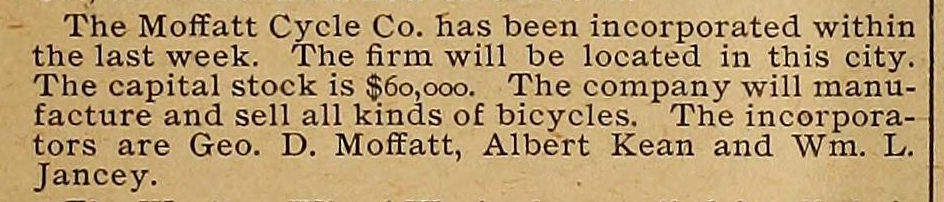
In January 1891, the Moffat Cycle Company was formed in Chicago. There were three people who put up capital. This company only made bicycles that were designed for racers in the popular cycle clubs of the day.
People at Moffat Cycle Co.
George D. Moffat is the president of the company. George Moffat was from New Orleans and became interested in bicycles while on business for three years in England. George Moffat was a member of the Illinois Cycle Club and the Lincoln Cycle Club and competes in amateur races.
William L. Jancey, one of the investors, is in 1892 Lakeside Directory of Chicago with occupation of machinist.
Edward M. Graham is in the 1892 Lakeside Directory of Chicago as foreman at the address of the Moffat Cycle Co factory. Edward Graham patents a “Truss” frame bicycle which the design appears to have begun while at Moffat Cycle Co..
Ignatz and Helene Schwinn arrive in Chicago at the end of April 1891. The 1892 Lakeside Directory of Chicago has Ignatz Schwinn occupation of blacksmith.
William J. O’Connell is in the 1892 Lakeside Directory of Chicago with occupation bookkeeper. He will be with Arnold, Schwinn & Co..
Ed C. Bode was an amateur bicycle racer and a sometime sales representative for the Moffat Cycle Co. and other bicycle companies. He will be with Arnold, Schwinn & Co..

The product of the Moffat Cycle Co.
The first Moffat was ridden in the Pullman road race on May 30, 1891. A promising racer by the name of Ed C. Bode of the Chicago Cycle Club rode the Moffat, . He finished third in a field of more than 100 racers. George Moffat also raced in that event and finished ninth.
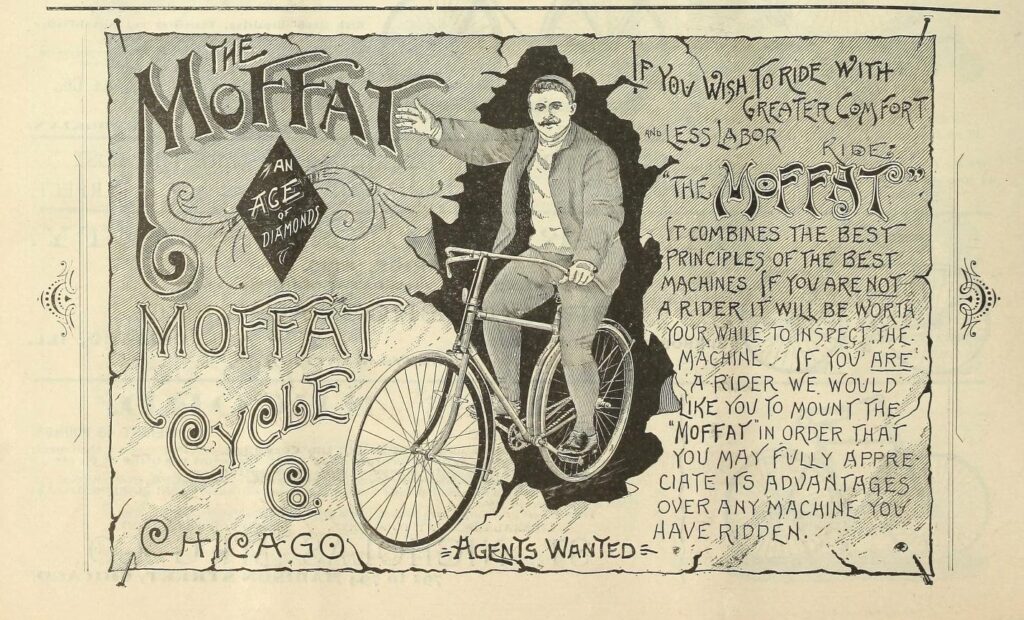
By July the company is producing bicycles and advertising in bicycle trade magazines. The bicycles are equipped with cushioned pneumatic tires. The production of the Moffat Cycle Company would have been sold locally, in Chicago. Several Moffats were sold to members of the Illinois Cycle Club, of which George Moffat was a member.

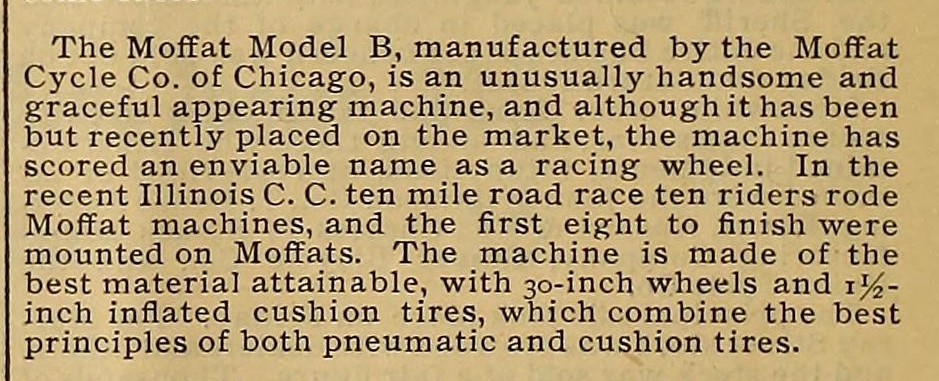
In August at an Illinois Cycle Club 10 mile race there are 10 riders on Moffat cycles. The first eight finishers are on Moffat bicycles and all Moffats were in the top eleven finishers.
The first Moffat model was known as the Model B and was popular with racers. Later a new sturdier model was designed and manufactured.

The new Moffat model will be patented by Edward Graham. The design is unique and has a wishbone shaped seat tube.
Too much, Too soon.
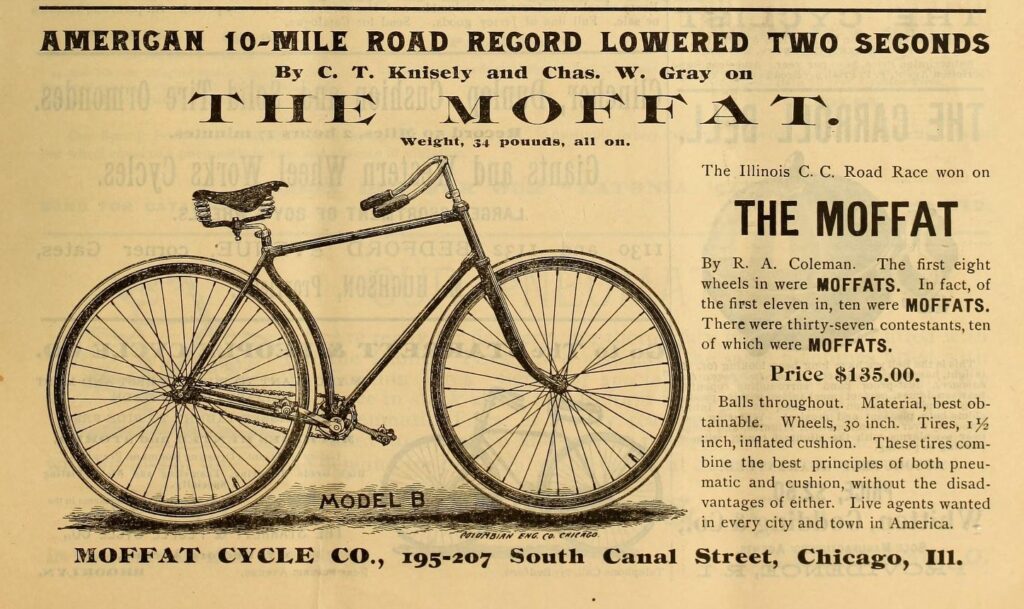
The bicycle trade magazines and Moffat advertising announce this unheard of level of racing success at the August race in Illinois.
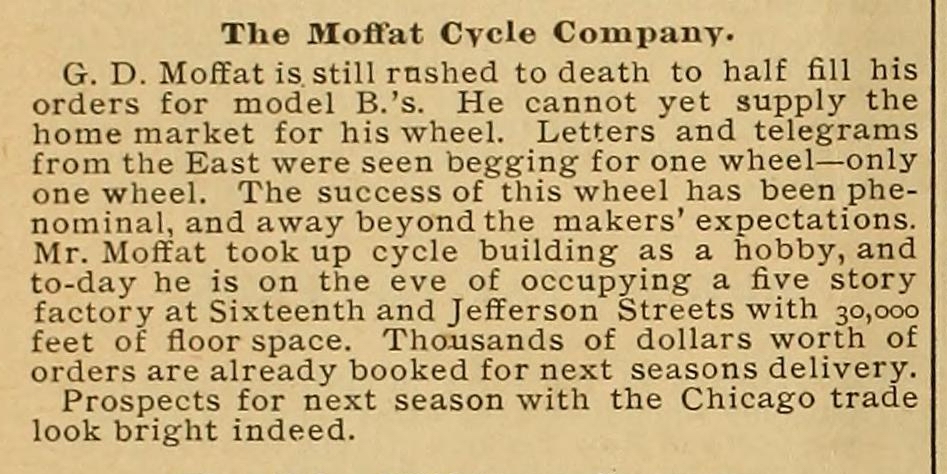
By October, the Moffat Bicycle is in demand from bicycle agents outside of Chicago. The Moffat bicycle is a big success. With all the good publicity the small factory cannot meet the demand from the new agents. This is a long way from the July 1891 Moffat advertisement stating “Agents Wanted”.
Will Success Spoil Rock Hunter?
The Moffat bicycle appears to be the first USA brand name to achieve a large level of attention in the bicycle club communities in the eastern United States and Great Lakes cities. It is a startup company that aimed for quality and the high end market of the bicycle club communities. The old manufacturers generally were aimed at the middle and lower end of the price conscious market.
After less than a year of operation and to capitalize on their success, the Moffat Cycle Co. takes on new investors and in December moves production to a larger premises.
What happens to this company next?
Stay tuned for the next instalment: The Moffat Affair.